
Integer direct counting
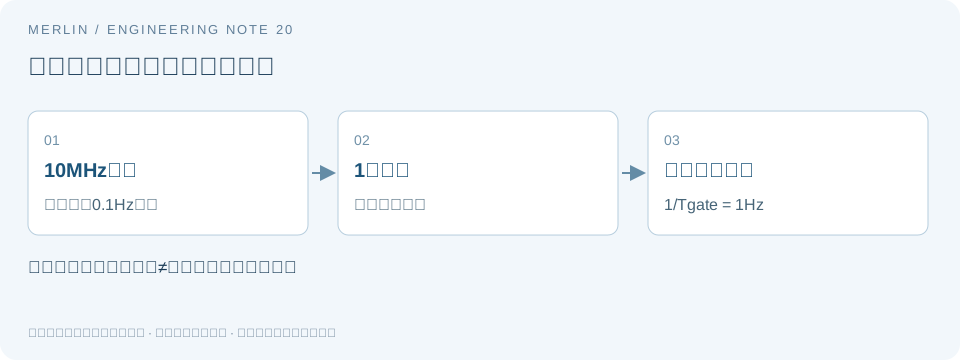
In the simplified model, count the integer number of input periods N in a gate of T seconds and estimate frequency as N/T. The result spacing is 1/T Hz, or ((1/T)/10,000,000) × 10⁹ ppb at a nominal 10 MHz.
| Gate T | One-count step | Relative to 10 MHz |
|---|---|---|
| 1 s | 1 Hz | 100 ppb |
| 10 s | 0.1 Hz | 10 ppb |
| 100 s | 0.01 Hz | 1 ppb |
Resolution, phase and accuracy
The increment describes quantization in this model. It does not establish instrument accuracy or oscillator jitter. At 10 seconds the target 0.1 Hz offset is only one count.
For a constant 10,000,000.1 Hz signal, a perfect 1 s window and initial phase φ measured in cycles, N = floor(fT + φ) − floor(φ). With φ = 0.05 and 0.95, the counts are 10,000,000 and 10,000,001. The difference reflects which edges landed inside the window.
from fractions import Fraction
from math import floor
f = Fraction(100000001, 10)
for phi in (Fraction(5, 100), Fraction(95, 100)):
    count = floor(f + phi) - floor(phi)
    print(count)
# 10000000
# 10000001
Read the specification in context
Taitien NF-10M-7000 Series section 2.1 lists temperature frequency stability as ±10 ppb relative to 25 °C over −40 to 85 °C. At 10 MHz, 10 ppb corresponds to 0.1 Hz. Absolute initial accuracy and other stability terms have separate entries.
When comparing before and after a temperature change, retain reference temperature, settling time, control voltage and supply conditions. A longer averaging window can smooth short-term behavior. Reciprocal counters, interpolation and timestamp-based estimators need their own instrument-specific resolution assessment.
Record the measurement chain
On the acceptance sheet, record counter method, gate or averaging time, reference and calibration, trigger settings, test load, temperature profile and uncertainty. Increasing the gate length alone does not remove timebase bias. Use the instrument manual and project error budget before choosing a method.
References and scope
MERLIN used AI assistance to compile this technical guide. Numerical examples are hypothetical unless identified as manufacturer specifications. They are not sample measurements, compatibility guarantees, or statements of availability.