
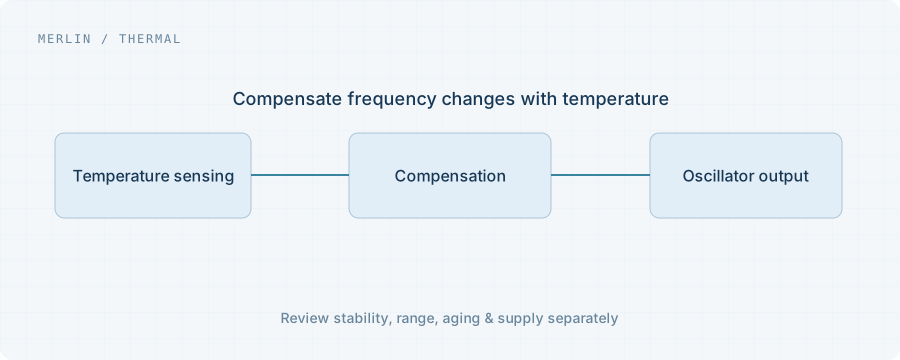
Express the system target consistently
One ppm is one millionth of nominal frequency. Separate a frequency-accuracy target from timekeeping error and short-term timing variation. Record operating temperature, supply range and service life before allocating a limit to the reference source.
Read the stability footnote first
A stability limit may include initial tolerance, temperature, supply or loading effects, while aging may be separate. Two ppm values can therefore represent different scopes. Build a comparison table of included effects and conditions before combining limits.
A scale example, not a device guarantee
A constant 20 ppm offset corresponds mathematically to about 1.728 seconds over 86400 seconds. This calculation illustrates scale only; it does not predict a real RTC across changing temperature, calibration and aging.
Make the requirement orderable
State the total-error target, temperature range, aging period and required inclusions. Review candidate definitions and engineering margin before ordering. A temperature-stability figure alone is not a system-accuracy guarantee.
Project checklist
- Total frequency-error allowance
- Temperature, supply and load ranges
- Aging period and included effects
- Datasheet revision and acceptance conditions