
Manufacturer condition
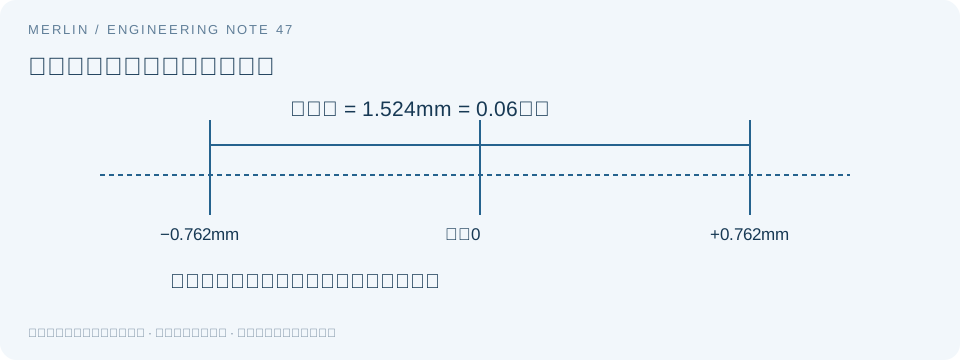
Section 7.4 of the Taitien NF-10M-7000 datasheet lists 0.06 inches total peak-to-peak over 10 to 55 Hz under non-operating vibration. Copy the displacement definition with the other conditions.
Convert the displacement without changing the test
For sinusoidal motion x(t) = A sin(2πft), A is one-sided amplitude and total peak-to-peak displacement is 2A. Using 25.4 mm per inch, 0.06 inches peak-to-peak is 1.524 mm, with 0.762 mm on each side. Writing ±0.06 inches instead doubles the total to 0.12 inches.
For sinusoidal motion the peak acceleration is (2πf)²A. Doubling A doubles peak acceleration at the same frequency, but this calculation does not establish a new qualification level. Sweep, direction and method must follow the specification and referenced standard.
| Entry | Value | Interpretation |
|---|---|---|
| Original specification | 0.06 in total p-p | Total excursion |
| Metric equivalent | 1.524 mm p-p | 0.06 × 25.4 |
| One-sided amplitude | 0.762 mm | Half the excursion |
| Incorrect ±0.06 in | 0.12 in p-p | Doubles the specified displacement |
Keep operating state and test definitions
List waveform, displacement basis, units, frequency range, direction and operating state separately. Convert peak, peak-to-peak and RMS descriptions before comparing reports. If the project requires powered operation or output performance during vibration, define that validation separately.
References and scope
MERLIN used AI assistance to compile this technical guide. Numerical examples are hypothetical unless identified as manufacturer specifications. They are not sample measurements, compatibility guarantees, or statements of availability.