
Are through-hole parts and DIP oscillators all passive crystals?
Use the original part number, supply, pinout, and output definition to identify the device. A passive HC-49 crystal and a powered DIP oscillator connect to different circuits.
Source HC-49S and HC-49U passive crystals and DIP8 and DIP14 oscillators. Use the listed part documentation to confirm electrical, mechanical, and mounting requirements.
Send MERLIN your full part number and application requirements to discuss sourcing, specifications, and samples.
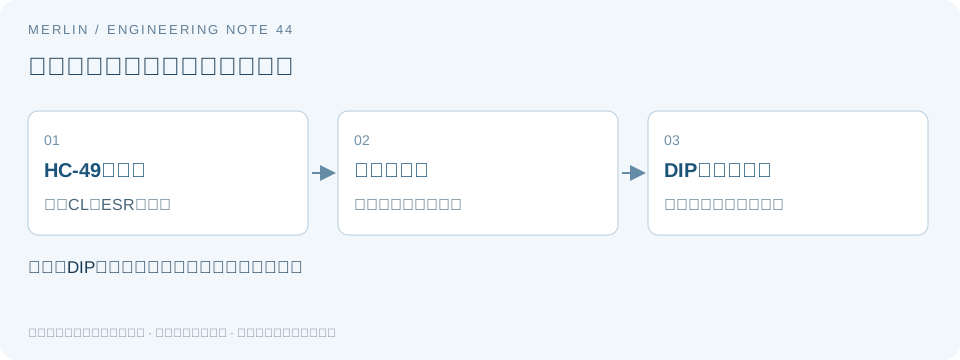
Through-hole describes the mounting method. A passive crystal works with an oscillator circuit, while an active oscillator requires power and supplies a clock output. Verify the electrical interface before substituting parts in similar metal packages or with similar pins.
The summaries below come from the corresponding series pages. Verify brand attribution for individual parts and confirm the available ordering combinations. Series listings by themselves establish neither EPSON, TXC, KDS, or TAITIEN affiliation nor availability.
| Series and part page | Specification summary | Full documentation |
|---|---|---|
| HC49/S Through Hole | Frequency (fo) 3.000–75.00 MHz · Tolerance at +25°C ±30 ppm standard, ±5 to ±100 ppm available · Temperature stability (TL) ±50 ppm standard (see Table 2) · Operating temperature (TOPR) −10 to +60°C standard (see Table 2) · Load capacitance (CL) 20.0 pF standard, 8–50 pF and series resonance available | View Full Specifications and Original Drawing |
| TGB · 49S Through-Hole Crystal | Frequency (fo) 3.2–36.000 MHz AT fundamental, 30.0–125.000 MHz AT third overtone, 26.8–54.000 MHz BT fundamental · Tolerance at +25°C ±30 ppm · Temperature stability (TL) ±30 ppm for AT cut (−20 to +70°C), ±50 or ±100 ppm for AT cut (−40 to +85°C), 0 to −100 ppm for BT cut (−20 to +70°C) · Operating temperature (TOPR) −20 to +70°C or −40 to +85°C · Load capacitance (CL) 8–32 pF or series resonance | View Full Specifications and Original Drawing |
| CXO 8-Pin DIP · Half-Size DIP8 Oscillator | HCMOS/TTL output · Supply 3.3 VDC ±10% or 5.0 VDC ±10% · Frequency (fo) 1.00–125.000 MHz or 1.00–160.000 MHz · Operating temperature (TOPR) 0 to +70°C standard or −40 to +85°C optional · Total frequency deviation (a + b + c + d) ±50 or ±100 ppm max. | View Full Specifications and Original Drawing |
| CXO 14-Pin DIP · Full-Size DIP14 Oscillator | HCMOS/TTL output · Supply 3.3 VDC ±10% or 5.0 VDC ±10% · Frequency (fo) 1.00–125.000 MHz or 1.00–160.000 MHz · Operating temperature (TOPR) 0 to +70°C standard or −40 to +85°C optional · Total frequency deviation (a + b + c + d) ±50 or ±100 ppm max. | View Full Specifications and Original Drawing |
Use the original part number, supply, pinout, and output definition to identify the device. A passive HC-49 crystal and a powered DIP oscillator connect to different circuits.
Verify case height, pin spacing, load capacitance, ESR, vibration mode, drive level, and temperature range before approving a substitution.
Provide the full part number or original datasheet, frequency, supply, output, enable requirements, actual pinout and package drawing, temperature range, quantity, and target delivery.
Send MERLIN the original part number or target specifications, quantity, and target delivery date to discuss sourcing, specifications, and samples. Confirm availability and purchasing terms separately.
For a request such as “4 MHz 49S,” “6 MHz 49S,” or “8 MHz 49S,” include the original part number, case height, pin spacing, and datasheet. Confirm the outline dimensions and board clearance for HC-49S and HC-49U separately, even at the same frequency.
Also check load capacitance, ESR, frequency tolerance, and temperature range for a through-hole passive crystal. For an older board, add photos of the pins and mounting location and specify the available PCB height. If you have only the marking, ask the supplier to identify and confirm the specifications first.
Browse Passive Crystals · Find Legacy Pericom and SaRonix Part Numbers · Crystal and Oscillator Sourcing
Brand, frequency, quantity and delivery target — a useful place to start.