
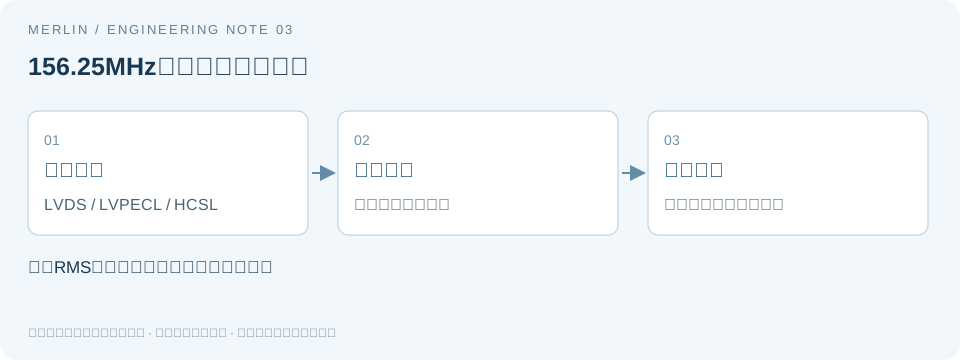
Confirm the output standard before reviewing frequency and package
Check the driver, receiver, and termination separately for LVDS, LVPECL, and HCSL. SiTime's differential termination application note covers these interfaces and explains how termination affects receiver bias and swing. Even if two devices share a 156.25 MHz frequency or a 7050 package, verify interchangeability against the oscillator and receiver documentation.
Specify measurable low-jitter requirements
Distinguish RMS phase jitter, period jitter, and other metrics in the RFQ. Record the integration bandwidth, output frequency, supply, and test conditions. The SiTime SiT3521 documentation lists phase jitter for different integration bands. Match the measurement conditions and compare guaranteed maximums separately from typical values.
Differential clock RFQ checklist
| Item | What to provide |
|---|---|
| Frequency and stability | Specify 156.25 MHz, allowed error, operating temperature range, and the error budget definition. |
| Output and receiver | LVDS, LVPECL, or HCSL, plus the receiver part number and input requirements. |
| Supply and control | Actual voltage range, OE/ST behavior, power-up and recovery timing requirements. |
| Package and pins | Outline, land pattern, pin assignments, height, and output polarity. |
| Signal quality | Jitter type, bandwidth, required typical or maximum value, and test conditions. |
| Sourcing and validation | Original part number, sample quantity, pilot build quantity, target delivery date, and validation plan. |
Decide which parts to sample
Compare the original and candidate datasheets and flag differences in supply, interface, pinout, and timing. Obtain engineering approval before arranging samples. During evaluation, check startup, lock, temperature range, and system signal quality, and retain the test conditions. Similar nominal values identify candidates for board-level validation.
What to send the supplier
Example RFQ: 156.25 MHz differential clock, output ___, supply ___, package ___, temperature range ___, phase jitter limit ___ (integration bandwidth ___), original part number ___, sample quantity ___, estimated production quantity ___. MERLIN can discuss documentation and sourcing using the full part number or these requirements. Confirm the specific configuration, price, and lead time.
156.25 MHz 7050 3.3 V LVDS Oscillator RFQ
MERLIN can discuss part numbers and purchasing terms using the original ordering code or the combined requirements of 156.25 MHz, 7050 package, 3.3 V, and LVDS output. If you have a BOM, include the full suffix and original datasheet. If you are sourcing from requirements, send the package drawing, pinout, receiver termination, temperature range, phase jitter and integration bandwidth, quantity, and target delivery. Confirm that each candidate meets all requirements against its datasheet and project validation.
Submit a 156.25 MHz LVDS RFQ →
Sourcing FAQ
Can I interchange 156.25 MHz LVDS and LVPECL oscillators?
Check the receiver, termination, supply, swing, common-mode voltage, pinout, and system validation requirements before approving a replacement.
Two datasheets say low jitter. Can I compare the numbers?
First match jitter definitions, integration bandwidth, frequency, supply, and test conditions. Compare typical figures separately from guaranteed limits.
Manufacturer References and Further Reading
This guide summarizes sourcing and general selection considerations. Use the current documentation for the selected device and host IC to confirm the design.
Next Steps
Sales contact · MERLIN Timing Components · sales@mecxtal.com.cn · 0755-26500570
Submit Part Number and Sourcing Requirements