
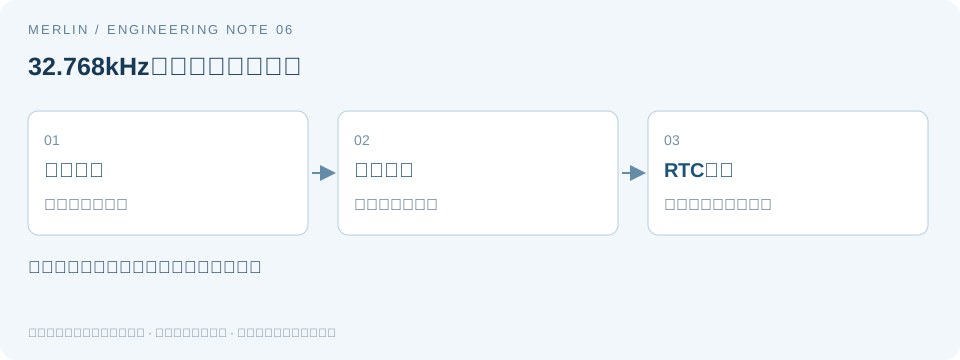
Identify the host input
Use the original datasheet or schematic to establish whether the device connects to oscillator pins or feeds an external clock input. For a passive crystal, check load capacitance, ESR and drive. For an active oscillator, check supply, output and power consumption. An RTC module may add a calendar, registers, a bus and backup-power functions.
Keep CL and ESR with the part specification
The Microchip crystal oscillator design guidance considers load capacitance and maximum ESR together. Procurement should preserve the crystal datasheet so engineering can compare it to the specific host oscillator circuit. Limits from one host design should not be applied to all RTC circuits.
| Request | Details to add |
|---|---|
| Need 32.768K | Confirm 32.768 kHz, active or passive, and original part |
| Need a drop-in replacement | Supply CL, ESR, drive, package drawing, operating temperature and error requirements |
| Need low power | Record host, supply, operating mode and system power target |
| Need accurate timing | Separate initial tolerance, thermal effects, aging and calibration |
| Need a second source | Provide original datasheet, mandatory parameters and validation plan |
Validate samples under the intended conditions
Keep original and candidate codes, datasheet revisions, circuit version, supply and temperature. Verify start-up, recovery and timekeeping as required. Changes to the crystal, capacitors or PCB layout may require another oscillator-circuit review.
A procurement-ready inquiry
Example: 32.768 kHz passive RTC crystal; original part ___; package ___; CL ___; maximum ESR ___; allowable drive ___; temperature range ___; tolerance ___; sample or pilot quantity ___; required date ___. For active devices, specify supply, output and power requirements. Confirm availability by complete part number.
Common questions
“32.768K” usually abbreviates 32.768 kHz in purchasing messages. Use the complete frequency and device type on the order. 32,768 Hz is equivalent. A passive crystal does not contain RTC functions. For an active clock, check input level, supply and enable. For an RTC module, also check the interface bus, backup supply and clock output.
References and scope
MERLIN used AI assistance to compile this technical guide. Numerical examples are hypothetical unless identified as manufacturer specifications. They are not sample measurements, compatibility guarantees, or statements of availability.