
Crystal & Frequency Control Componentssales@mecxtal.com.cn0755-26500570
Sourcing and Selection Guide · 2026-11-04

25 MHz 3225 Crystal Sourcing, CL, ESR, and Drive Level

Updated 2026-11-17 · One technical case added

Confirm whether the circuit requires a passive quartz crystal or a powered clock oscillator. Then check the original part and the host IC's oscillator requirements. The 25 MHz frequency and 3225 outline illustrate the sourcing process. Confirm the availability of each configuration separately.

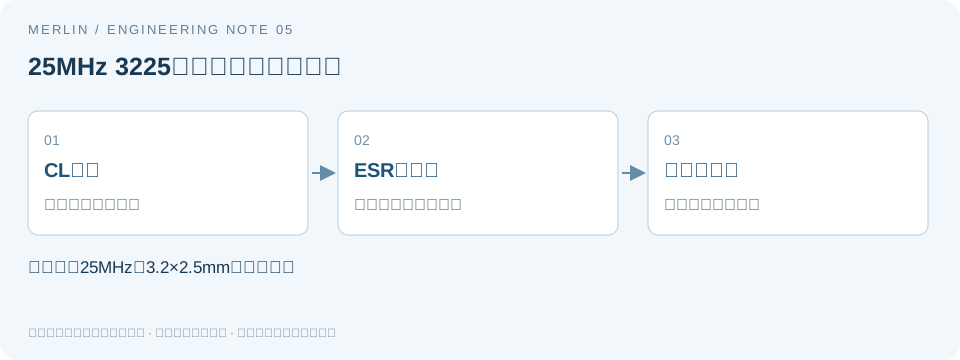
Selection checks for a 25 MHz 3225 crystal
Original diagram (Chinese labels). Illustration by MERLIN, based on this guide and the cited manufacturer references. Manufacturer reference 1 ↗ Manufacturer reference 2 ↗ See the relevant sections for specific values and conditions.

Identify a passive crystal or an active oscillator

A passive crystal works with the oscillator circuit inside the IC. An active oscillator requires power and provides a clock output. Two parts with the same nominal frequency can have different connections. Include the schematic interface or original datasheet in the RFQ and specify the device type so buyers can distinguish 25 MHz parts in similar packages.

Evaluate load capacitance at the circuit level

Select the crystal's CL with the external capacitors, IC pin capacitance, and PCB parasitics in mind. Epson's guidance for the NXP LPC series lists CL, oscillation capability, and drive level as design checks. A replacement at the same frequency and in the same package still needs these checks. Use the applicable controller documentation for other IC families.

Review ESR and drive level with engineering

Purchasing should obtain the full datasheet. Engineering should check maximum ESR, startup margin, and permissible drive against the oscillator circuit's requirements. Compare specifications at the same frequency, CL, and test conditions. Use chip-specific application limits for the design.

What to include in an RFQ

InformationWhy it matters
Brand and full part numberIdentify the original device and record all suffixes that affect specifications.
Frequency and toleranceSpecify 25 MHz and the applicable conditions. Record stability over temperature separately.
CL, ESR, and driveMatch the host IC's oscillator design requirements.
Dimensions and footprint drawing3225 gives the nominal outline. Confirm height, pads, and pins.
Quantities and deliveryList sample, pilot, and estimated production requirements separately.

Qualify a domestic replacement or second source

Build a side-by-side comparison of the original and candidate part numbers. Flag differences in CL, ESR, drive, package, and temperature range. After engineering accepts a candidate for evaluation, check startup and operation under the project conditions. Matching 3225 packages and frequencies still require validation. Record the sample part number, test revision, and purchasing lot for traceability.

Example RFQ

25 MHz passive quartz crystal, 3225 package, CL ___, maximum ESR ___, allowable drive ___, temperature range ___, tolerance ___, original part number ___, quantity ___, target delivery ___. Mark unknown fields as pending confirmation. MERLIN can discuss specifications and candidates from these requirements. Confirm available part numbers, price, and lead time for each candidate.

Sourcing FAQ

Can I interchange two 25 MHz 3225 crystals?

Compare CL, ESR, drive, temperature range, tolerance, and package details, then validate the change in the circuit.

Can I use the external capacitance as the crystal's CL?

Use the original datasheet and circuit design to determine CL. It represents the effective load at the crystal.

Manufacturer References and Further Reading

This guide summarizes sourcing and general selection considerations. Use the current documentation for the selected device and host IC to confirm the design.

Next Steps

Sales contact · MERLIN Timing Components · sales@mecxtal.com.cn · 0755-26500570

Submit Part Number and Sourcing Requirements

Checking 3225 and 5032 Packages for a 25 MHz SMD Crystal

If a request says “25 MHz SMD crystal,” “25 MHz 3225,” or “25 MHz 5032,” start with the PCB footprint and original part number. When changing packages at 25 MHz, verify dimensions, footprint, and pinout. For passive crystals, also check CL, ESR, frequency tolerance, and temperature range.

If the original datasheet lists power and clock output pins, follow the active oscillator checks. Include the manufacturer's documentation and quantities when requesting a quote. Confirm availability against the full part number and delivery requirements.

Browse Passive Quartz Crystals · Browse Active Oscillators · Back to Crystal and Oscillator Sourcing

Validating CL, ESR, and Drive When Replacing a 25 MHz Crystal

25 MHz and 3225 identify the frequency and nominal outline. In a passive crystal replacement, load capacitance affects the operating point, ESR affects oscillator startup, and drive power determines the crystal's operating conditions. Verify all three together, including when the expected frequency is measurable.

1. Define the effective load capacitance

Crystal CL is the nominal load at the operating point. In a two-capacitor Pierce circuit, estimate it using CL ≈ C1C2/(C1 + C2) + Cstray. Define Cstray according to the model. If the IC offers programmable internal load, record the register settings alongside the PCB capacitance.

With C1 = C2 = 15 pF and 3 pF of effective stray capacitance, CL is about 10.5 pF. With 18 pF on both sides, it is about 12 pF. The 1.5 pF difference does not give a fixed frequency shift in ppm. Frequency pulling also depends on crystal and circuit parameters.

2. Use maximum ESR and the actual oscillator conditions

A lower typical ESR by itself leaves the maximum ESR over temperature unknown. Record the guaranteed maximum, frequency, and temperature range, then evaluate startup margin using the host IC manufacturer's method. Use the actual IC guide for the conditions and factors in negative-resistance or transconductance methods.

After increasing the capacitors to tune frequency, check startup again. The oscillator and its load must be evaluated together even when capacitance increases or candidate ESR decreases.

3. Calculate drive power from the square of the current

In an appropriate equivalent circuit, P = Irms² × Re, where Re is the model's effective resistance. If Re = 40 Ω, crystal current of 0.5 mA RMS gives 10 µW. At 1 mA RMS, power reaches 40 µW. Doubling current quadruples power.

These inputs are hypothetical. Use the datasheet for the permitted drive of the exact 25 MHz crystal. Dividing the digital output voltage by crystal ESR does not yield the crystal current. Effective resistance depends on the model and the load. Use a manufacturer-approved measurement method and check how the measurement affects the circuit.

4. Validate and document the replacement

First verify the circuit type and pinout, then CL, maximum ESR, and drive. Record startup and steady-state frequency at the project's specified temperature and supply limits. Test the original part on the same board and record failure behavior alongside load settings and measurement connections.

A single trial covers the samples and conditions tested. For a production change, record the full ordering code, board revision, and acceptance criteria. Mark missing temperature-range or life-test data as pending validation. Confirm production reliability separately.

Calculations and Test Records

AssumptionsResultInterpretation
15 pF/15 pF, 3 pF strayCL≈10.5pFSimplified model
18 pF/18 pF, 3 pF strayCL≈12pFRecheck startup
0.5mA rms、Re=40Ω10µWHypothetical value
1mA rms、Re=40Ω40µWDoubling current quadruples power

References and Scope

This analysis draws on public sources and was prepared with AI assistance. All examples use hypothetical values. Confirm product specifications and compatibility against the exact ordering configuration, the latest manufacturer datasheet, and board-level validation.

Manufacturer reference Epson Crystal Device Glossary.

Related Selection Guides

For BOM and RFQ fields, see MERLIN's guide to passive crystal CL, ESR, and drive. Confirm specifications against the applicable manufacturer datasheet and project validation.

Let’s work from your requirements.

Brand, frequency, quantity and delivery target — a useful place to start.

WeChat

MERLIN · TIMING COMPONENTS

Scan with WeChat to connect

Add our WeCom contacts from your usual WeChat app.

On desktop, scan with your phone. On mobile, save the QR image and select it from your album in WeChat Scan.